
There is a particular kind of collector who, after years of chasing dive watches and chronographs and limited editions, eventually arrives at a quiet truth: the watch you reach for most mornings is rarely the one that shouts the loudest. It is the one that fits. The one that feels inevitable. The Tudor 56000 Glamour Date+Day is that watch for me.
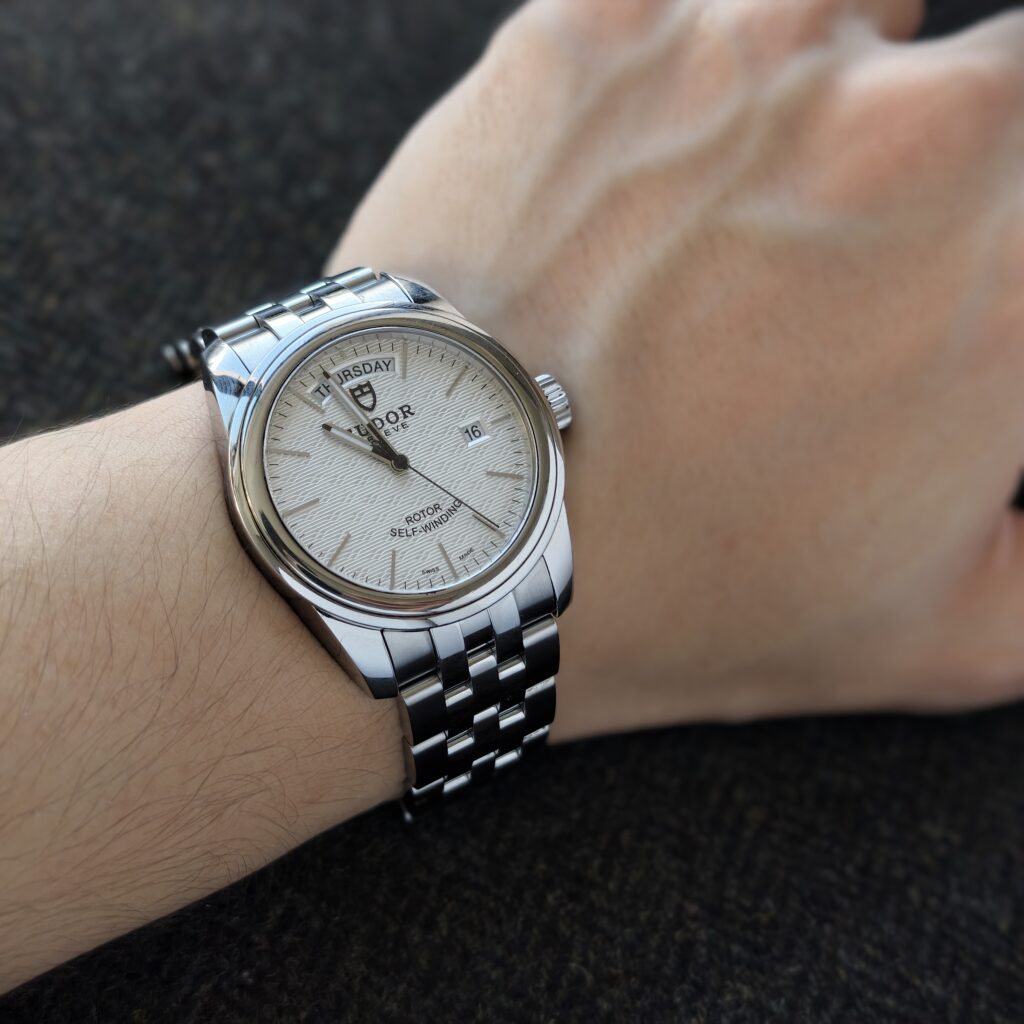
I own other Tudors. I have handled dozens more. But the 56000 occupies a space in my collection that nothing else quite fills — a space defined less by what it is than by what it refuses to be. It is not a dive watch pretending to be a dress watch. It is not a dress watch apologizing for being too delicate. It is simply a well-proportioned, all-steel, day-date automatic with a dial that stops you mid-sentence when the light hits it just right. And sometimes, that is enough. More than enough.
The Dial: A Study in Restrained Texture
Let us begin where it matters most — the dial.
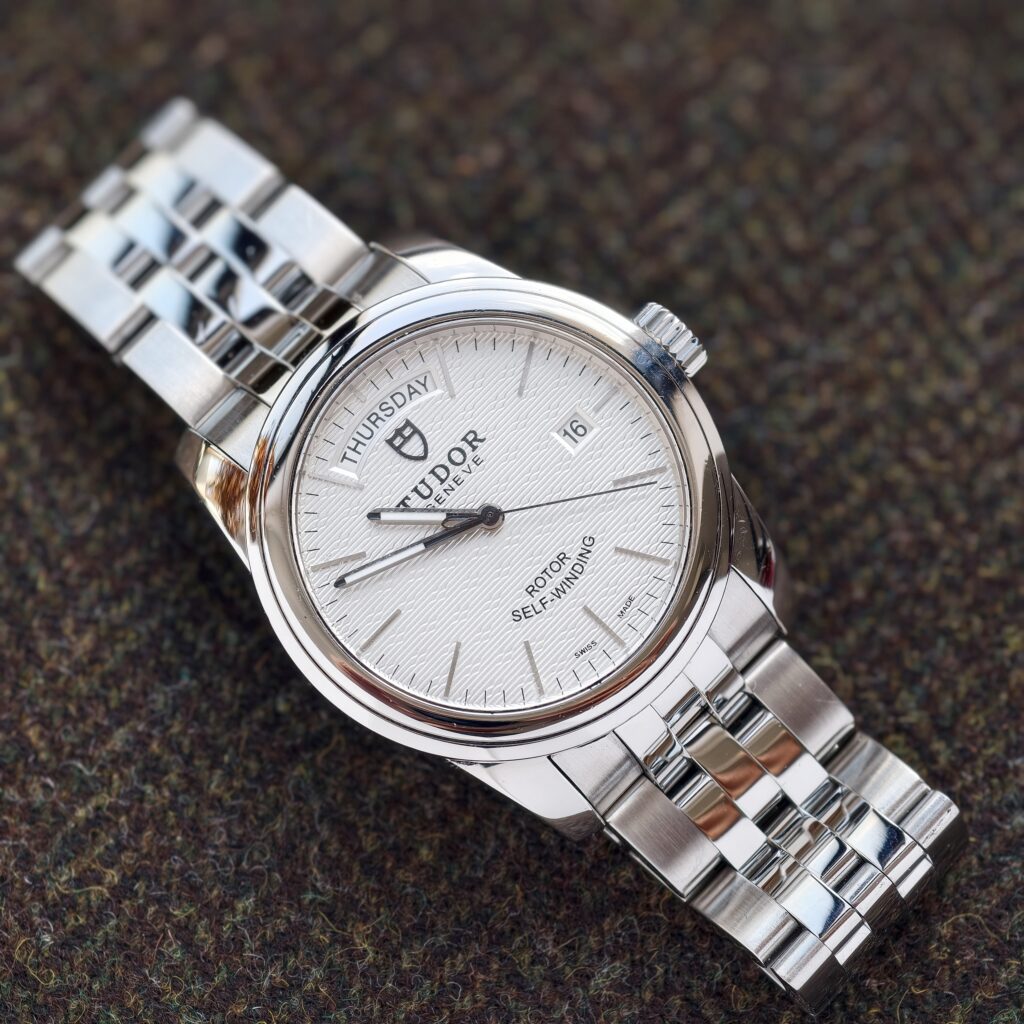
Hold it under a lamp and what first registers is silver. Clean, bright, almost clinical silver. But tilt the wrist, and the surface comes alive. This is not a flat lacquered dial. It is not a sunburst. It is a finely engraved wave pattern — a repeating, undulating guilloché that ripples across the entire surface like water viewed from directly above, or like the grain of a fine fabric stretched taut across a frame. Tudor called it an “opaline” dial in their catalogs, but that clinical term does the texture a disservice. This is a dial that was engraved, not printed. You can feel the ridges if you run a loupe across them. You can see the light catch each successive wave at a slightly different angle, producing a shimmer that shifts as the watch moves.
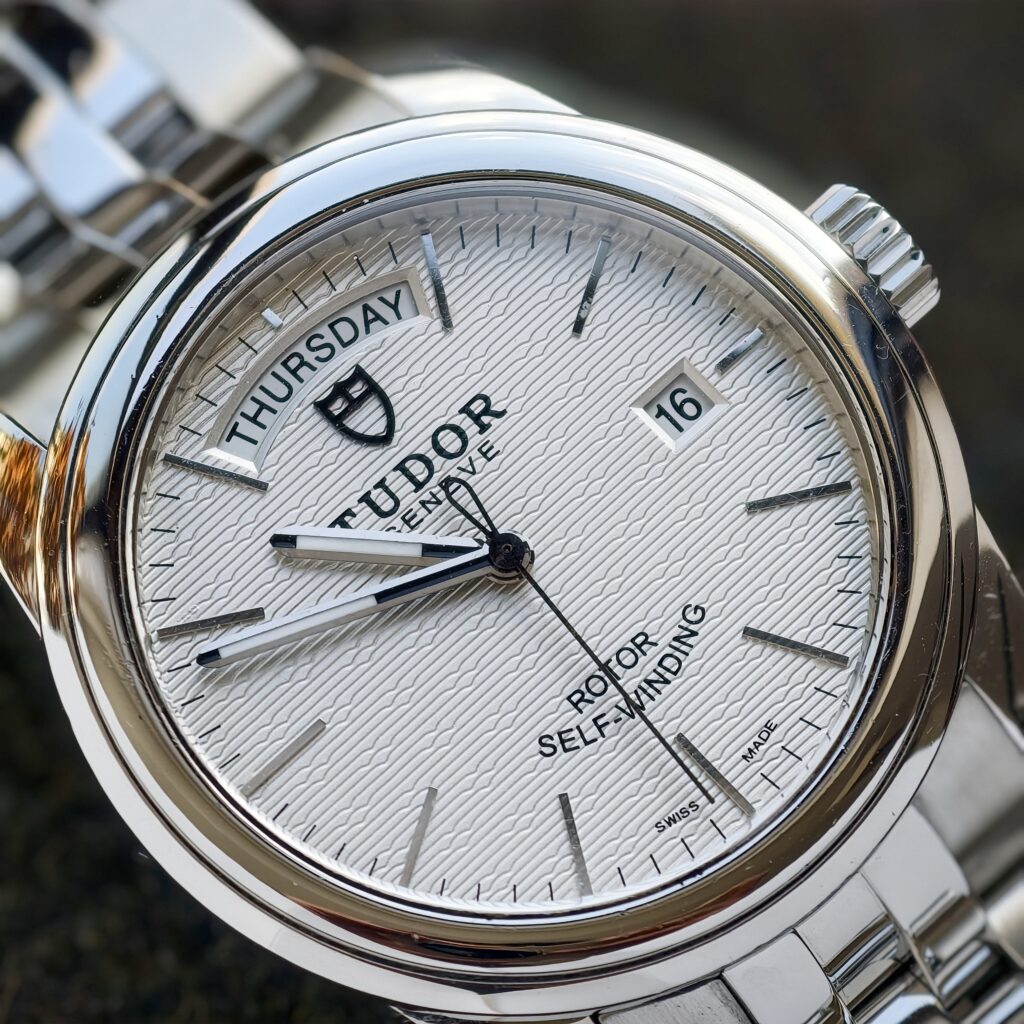
The day window at twelve o’clock is curved — arched to follow the dial’s contour — and prints the day in clean, serif-free capitals. “THURSDAY,” in the photographs, but every day of the week looks correct in that window. The date at three o’clock sits in a simple rectangular frame, and the two complications together give the dial a symmetry that feels intentional rather than incidental. This is the classic day-date layout, executed with a restraint that Rolex’s Day-Date somehow abandoned decades ago in favor of Roman numerals and precious metal.
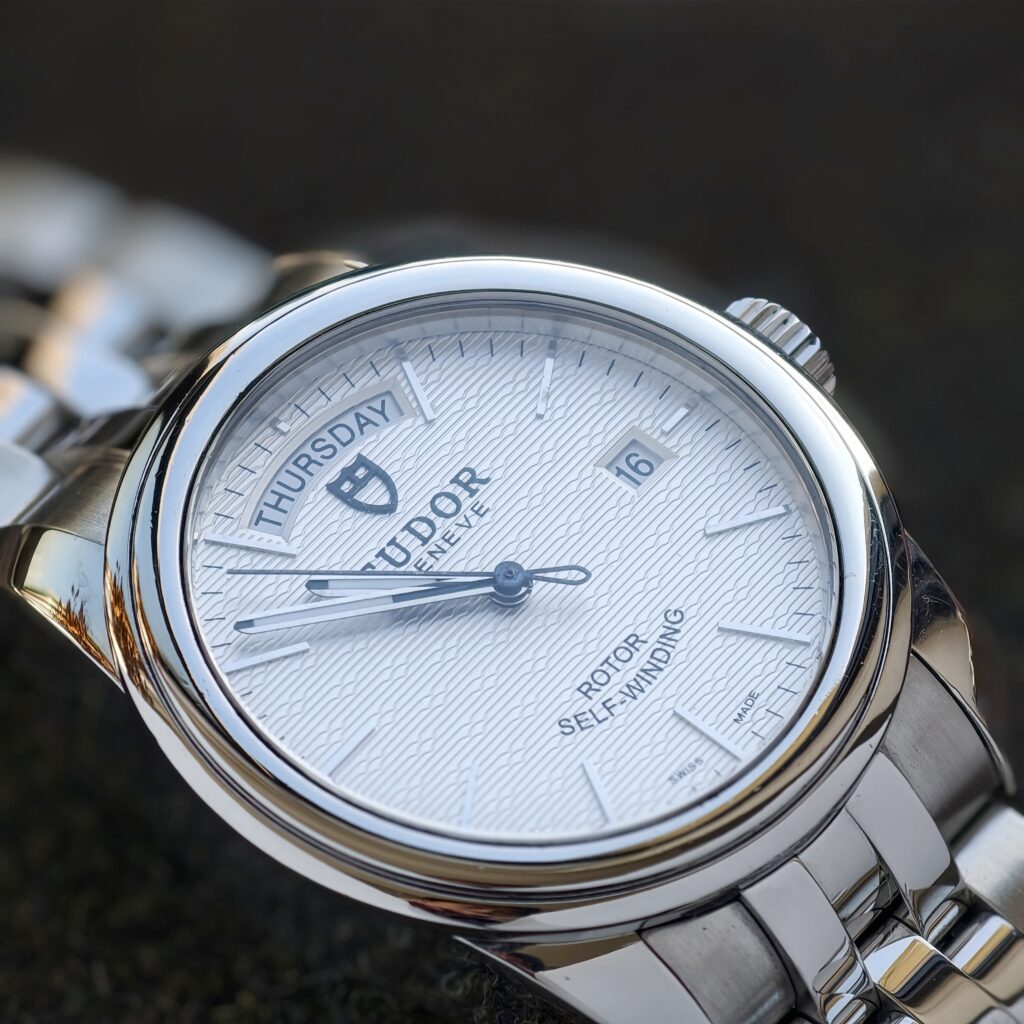
The applied bar indices are polished steel with black-edged tips — a small detail, but one that adds definition and legibility in low light. The sword hands are similarly two-toned: polished steel centers bordered in black, with a thin luminous strip running down the middle. They are not dramatic hands. They are not cathedral hands or Mercedes hands or any of the usual horological shorthand. They are simply right for this dial — proportioned, precise, and unobtrusive.
The text is minimal by Tudor standards. “TUDOR GENEVE” beneath the shield at twelve. “ROTOR SELF-WINDING” in the lower right quadrant. “SWISS MADE” tucked discreetly at six. No depth rating. No red accents. No marketing slogans. The dial speaks for itself, and it speaks in a whisper.
The Case: 39 Millimeters of Proportion
At 39 millimeters, the 56000 is, to my mind, the perfect size for a watch of this type. Not 36, which feels like a concession to vintage fetishism. Not 41, which begins to announce itself. Thirty-nine. A dimension that disappears under a dress shirt cuff and yet reads as substantial on a bare wrist.
The case is polished stainless steel throughout — no brushing, no two-tone, no ceramic. Just honest, mirror-finished steel that reflects the world around it. The bezel is smooth and slightly domed, framing the sapphire crystal with a continuous curve that catches light from every angle. There is no fluting here, no engine-turned insert, no decorative element whatsoever. The bezel’s job is to hold the crystal and look good doing it, and it performs both tasks with quiet competence.
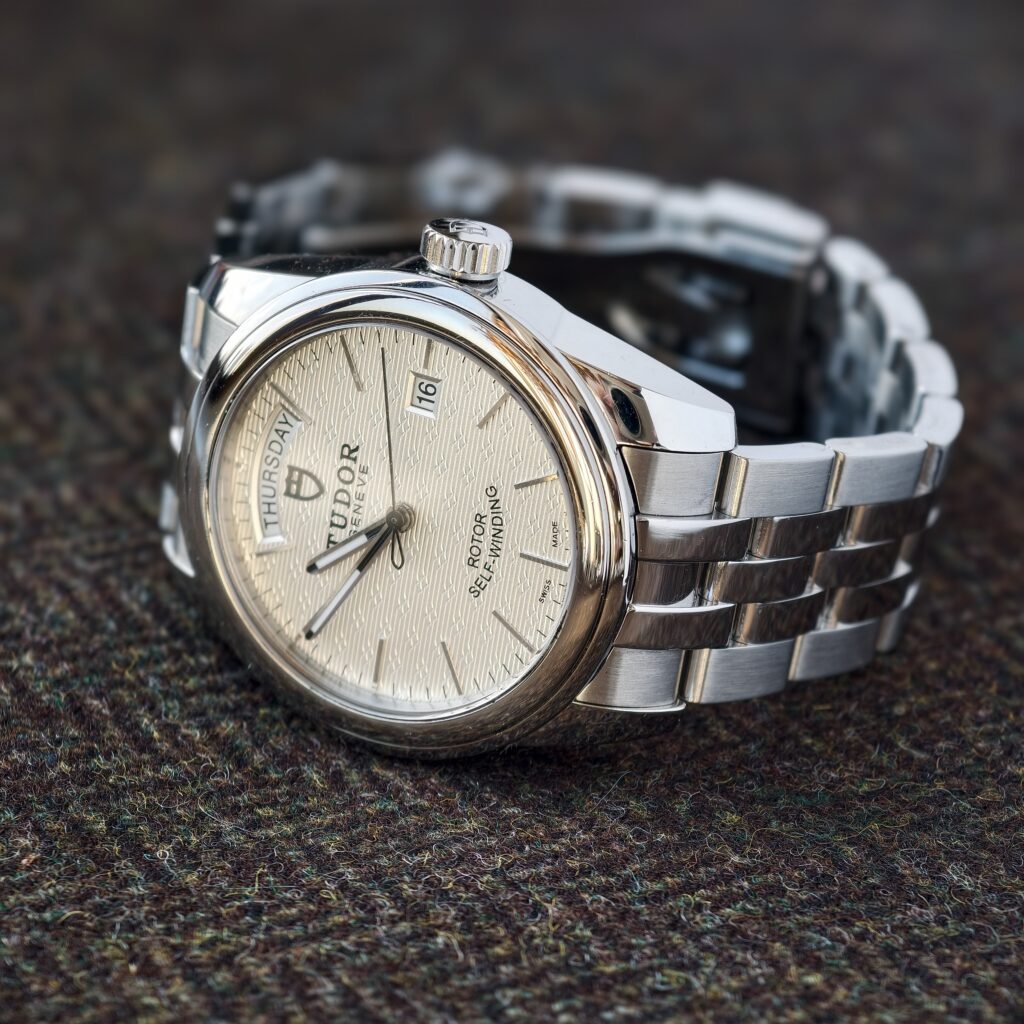
The lugs are gently curved — not aggressively so, but enough to wrap the wrist and keep the watch from sitting flat like a puck. The lug-to-lug distance is reasonable, the case thickness is modest, and the overall silhouette is one of elegant purpose. This is not a watch that needs a custom strap or a nato band to look right. It was designed to be worn on its bracelet, and it was designed well.
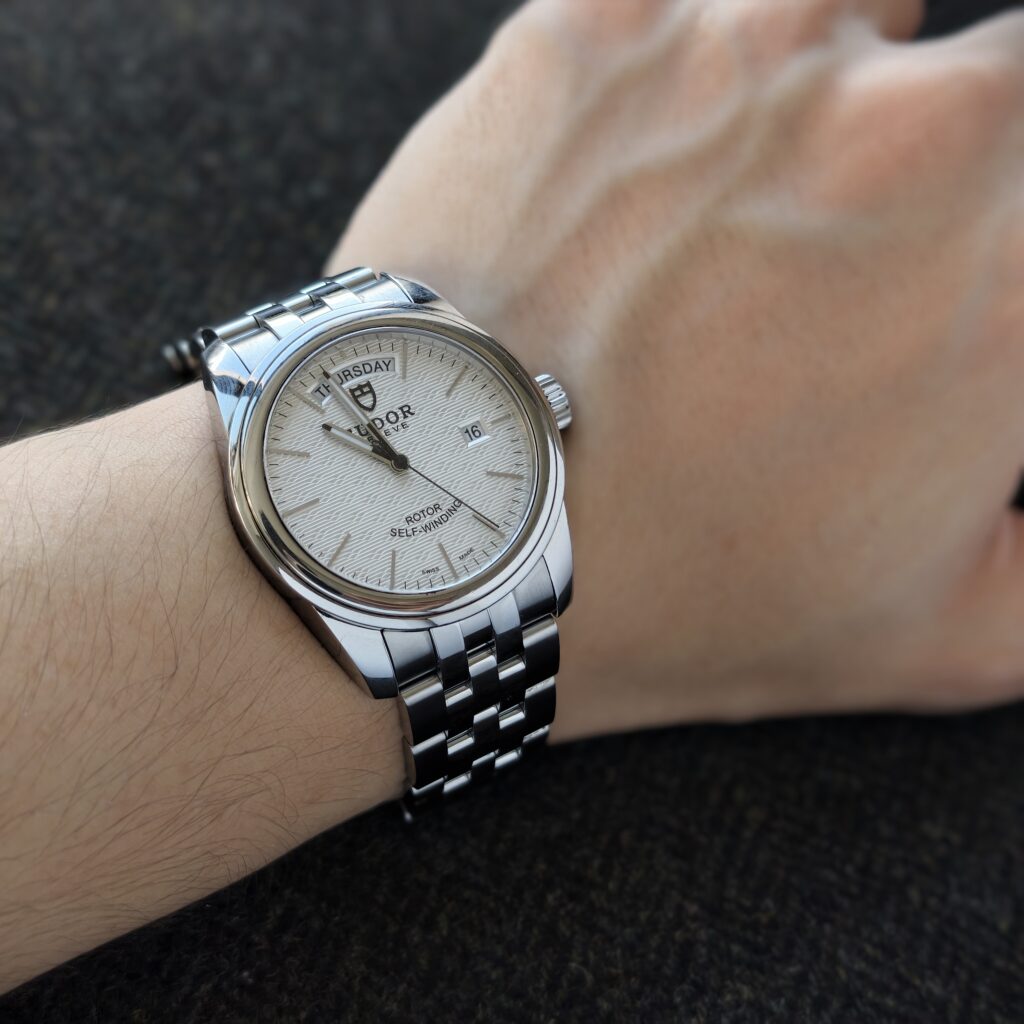
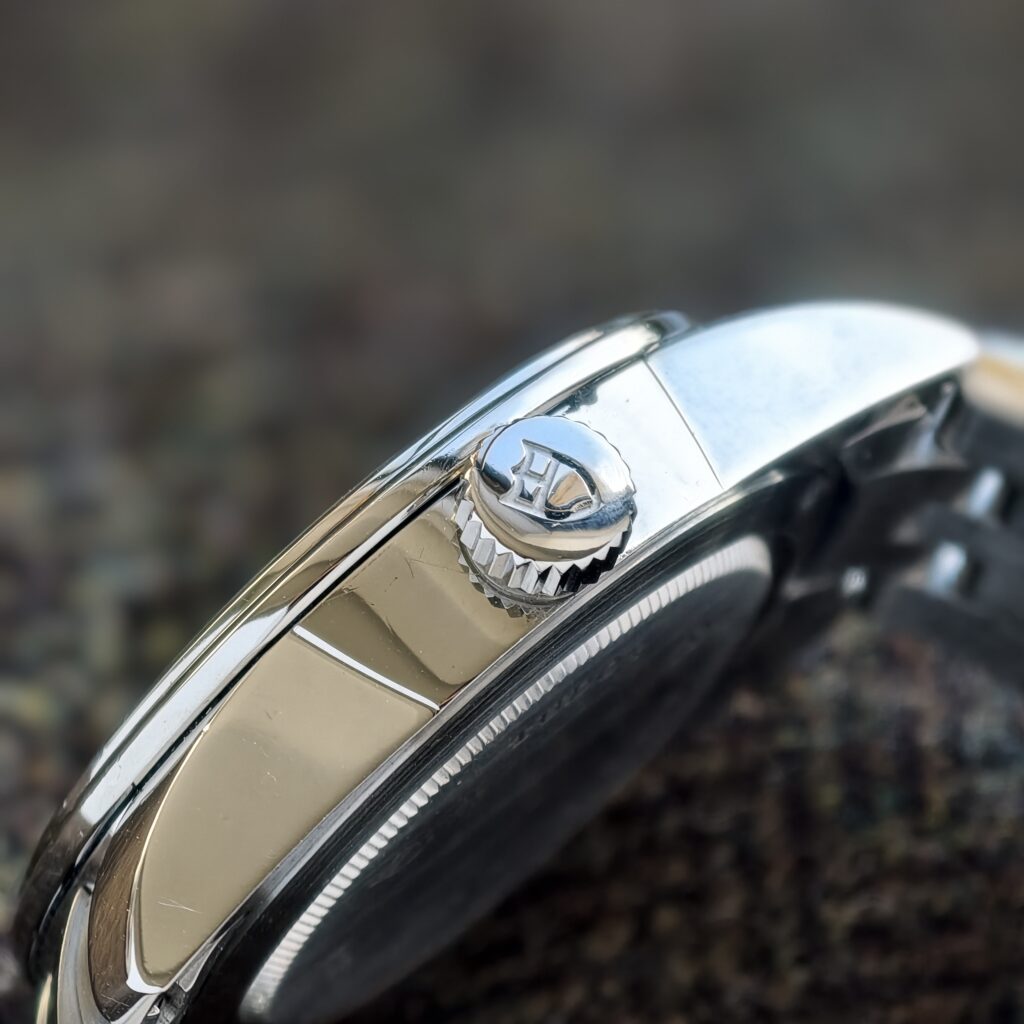
The screw-down crown at three o’clock is signed with the Tudor shield — deeply engraved, not printed — and knurled for grip. It is a small thing, but a signed crown on an all-steel watch at this price point was, for many years, far from guaranteed. It is a detail that signals intent: Tudor built this watch to be taken seriously.
The photographs reveal honest wear — fine hairlines on the polished bezel, light swirls on the case flanks. I would not polish them away. Those marks are the watch’s autobiography. They are evidence that this 56000 has been lived with, not merely stored. A watch that has never been scratched is a watch that has never been loved.
The Bracelet: A Five-Link Jubilee, All Steel
The bracelet is where Tudor consistently punches above its weight, and the 56000’s five-link jubilee is no exception.
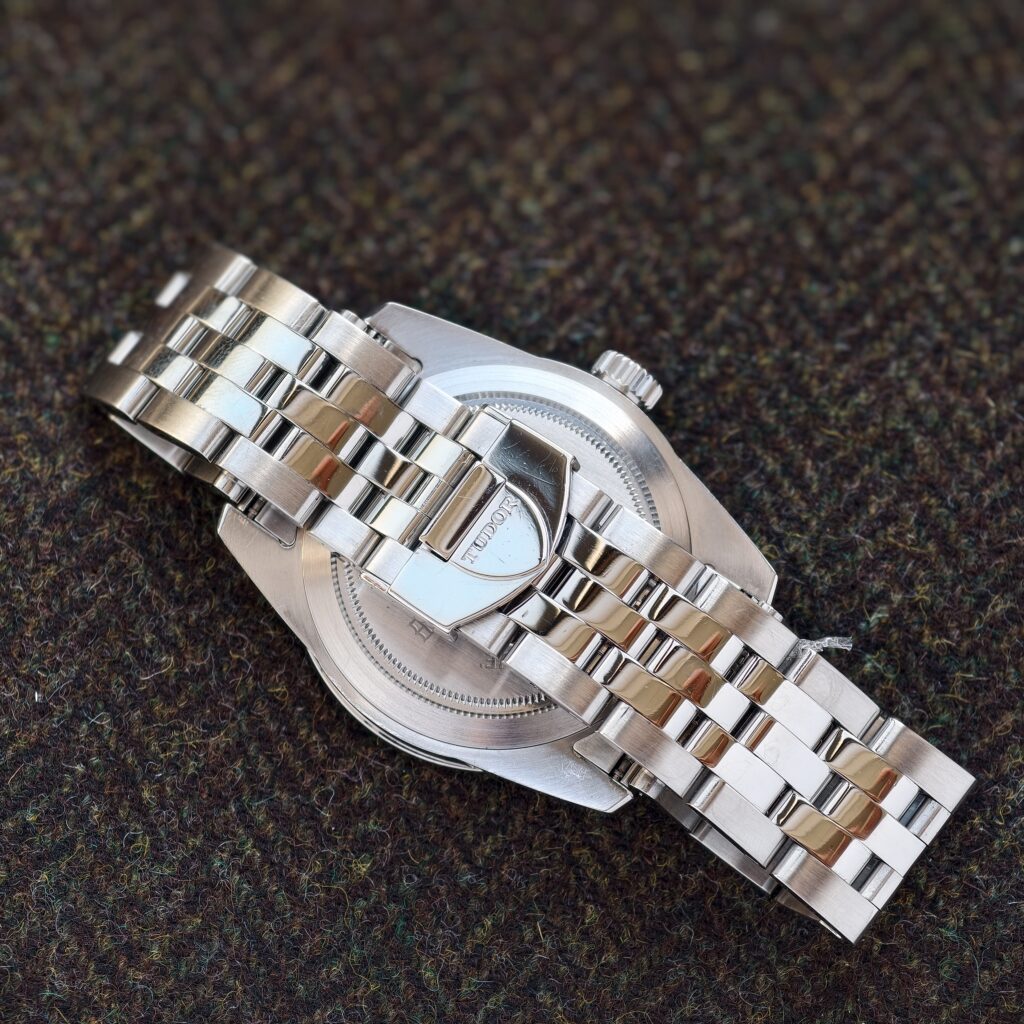
Alternating polished center links with brushed outer links, the bracelet articulates with a fluidity that belies its all-steel construction. It conforms to the wrist rather than fighting it — a quality that cheaper bracelets, even those from brands with greater prestige, often fail to achieve. The links are solid, not folded. The end pieces fit the case with a precision that leaves no gap, no rattle, no sense of compromise.
The folding clasp is a study in understatement. Brushed steel on the outside, with the Tudor shield engraved into its surface — not applied, not printed, but engraved, deep enough to feel with a fingertip. It opens with a firm double-click and closes with the satisfying certainty of a well-machined mechanism. No micro-adjustments. No fancy quick-release system. Just a clasp that works, every single time, and will continue to work for decades.
This is an all-steel bracelet on an all-steel watch. There is no gold to wear through, no plating to worry about. It will age the way steel ages — gaining character, accumulating scratches, developing a patina that is uniquely yours. And that, to a collector, is the point.
The Movement: What Lies Beneath
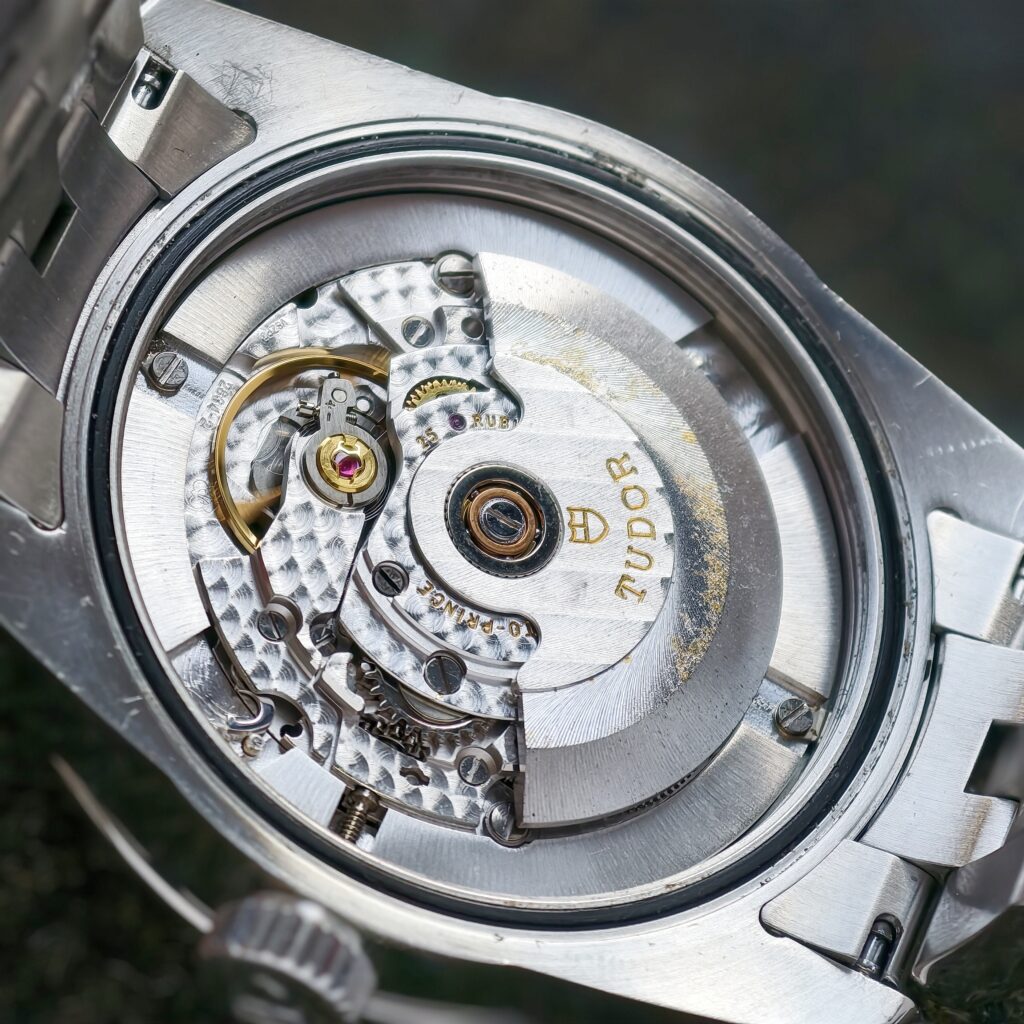
One of the photographs shows the caseback removed, and for a collector, this is where the conversation gets interesting.
What you see is a Tudor-signed rotor — large, brushed, with the shield and “TUDOR” deeply engraved in gold — mounted atop an ETA 2834-2 base movement. Twenty-five jewels. Perlage finishing on the bridges. A gold-colored screw securing the balance cock. Incabloc shock protection visible at the balance wheel. The markings “2834-2” and “ETAW” are legible, confirming the movement’s provenance.
Is this an in-house movement? No. Is it COSC-certified? No. Does it have a silicon hairspring or a 70-hour power reserve? No.
And here is the thing that modern watch marketing would have you forget: none of that matters.
The ETA 2834-2 is one of the most proven, most serviceable, most reliable automatic movements ever produced. It has powered millions of watches across dozens of brands over more than four decades. Any watchmaker in any city in the world can service it. Parts are abundant. Costs are reasonable. It will run for fifteen, twenty years between services if treated with ordinary respect. The bi-directional winding is efficient. The date changeover is crisp. The accuracy, when properly regulated, is well within chronometer standards even without the certificate.
In a market increasingly obsessed with proprietary calibers and boutique engineering, the 2834-2 is a reminder that a movement’s purpose is not to be discussed on internet forums. Its purpose is to keep time, day after day, year after year, and to be fixable when it eventually stops. The 2834-2 does all of those things, and it does them with a track record that no in-house movement less than a decade old can claim.
Tudor’s finishing of the movement — the perlage, the gold rotor, the attention to detail on components that the wearer will never see — is a quiet signal. It says: we know this is a workhorse movement, but we are going to finish it like it matters. Because it does.
Why This Watch Deserves Your Attention
The Tudor 56000 Glamour Date+Day is a watch that rewards the patient observer. It does not impress on first glance. There is no ceramic bezel, no helium escape valve, no GMT hand, no chronograph complication to draw the eye. What it has is a dial texture that you will notice on the third or fourth look, a case proportion that feels right the moment you put it on, and a movement that will outlast trends, fashions, and perhaps even you.
It is the kind of watch that other collectors notice — not because it is expensive or rare, but because it is correct. The size is correct. The proportions are correct. The dial is correct. The bracelet is correct. There is a particular pleasure in wearing a watch that every other collector would recognize as a sound choice, even if no one else on the street would glance twice.
In a world of 42mm dive watches with neon accents and 600-meter depth ratings, the 56000 is a reminder that not every watch needs to be an instrument. Some watches are simply meant to be worn — to meetings, to dinners, to quiet weekends, to the ordinary business of living. And the 56000 does that better than almost anything in its price range.
I have owned this watch for long enough to know that it will never be the most valuable piece in my collection. It will never be the rarest. It will never be the one that generates the most conversation at a meet-up. But it is the one I reach for when I want to feel put-together without trying. It is the one that fits my wrist, my wardrobe, and my life. And in the end, that is the highest recommendation a collector can give.
This exact Tudor 56000 Glamour Date+Day — with its silver wave-texture dial, all-steel case and bracelet, and proven ETA 2834-2 movement — is available now on my website. If you have been looking for a daily wearer that combines classic proportions with a genuinely distinctive dial, I encourage you to take a closer look. You will not be disappointed.
