
There is a particular kind of watch that does not announce itself. It sits on the wrist with the unhurried confidence of something that has already proven itself, and it asks for nothing. The Tudor 23013 is exactly that kind of watch.
I have handled my share of two-tone sports watches over the years — Rolex Datejusts, Omega Seamasters, the usual suspects — and I keep returning to this reference with a kind of guilty pleasure. It is not rare in the way that makes auction houses salivate. It is not historically significant in the way that fills books. But it is honest, and in a market saturated with limited editions and manufactured nostalgia, honesty has become a currency all its own.
The Dial: Where This Watch Earns Its Keep
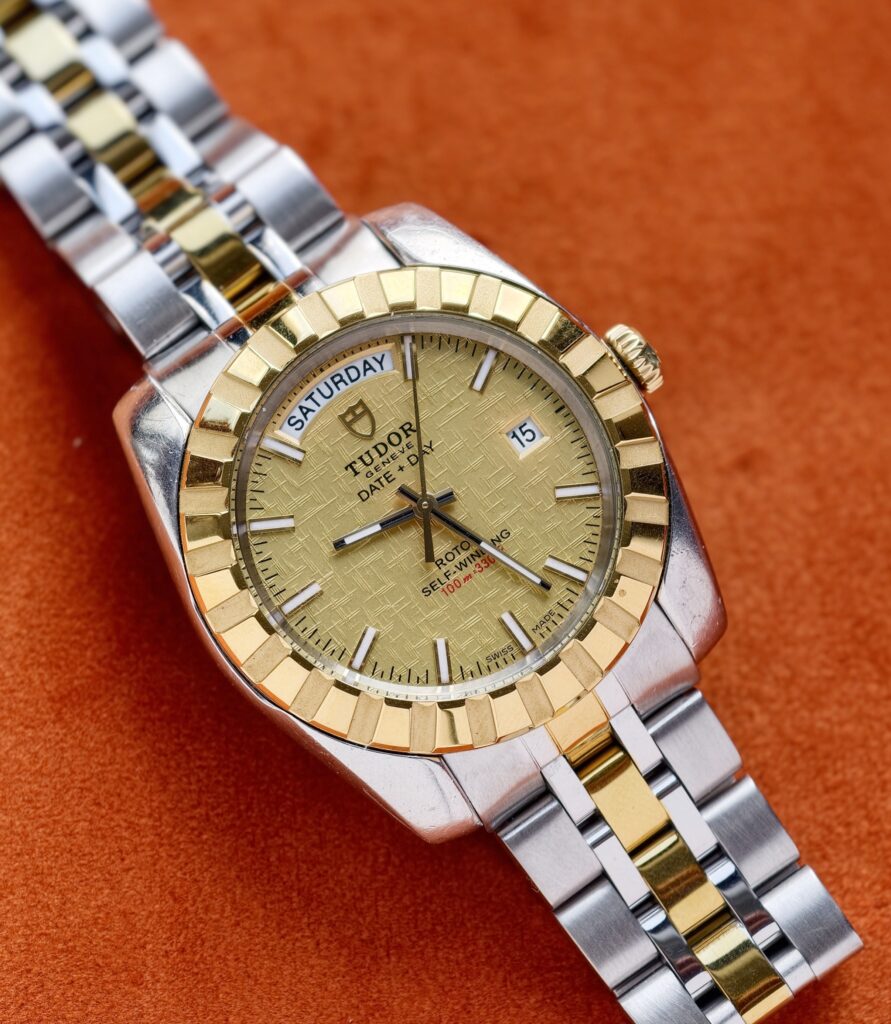
Look closely at the dial. Not a quick glance — closely. What you see is a champagne ground finished in a fine cross-hatched linen texture, a pattern that Tudor executed with more care than this price point ever demanded. Under direct light it shimmers like shot silk; in shadow it settles into a warm, almost coppery gold that flatters the two-tone case without competing with it. This is not a flat stamped dial. This is a dial that someone thought about.
The day window at twelve o’clock is framed in white and prints the day in clean, unadorned capitals — “SATURDAY” in the photograph, but any day of the week looks right there. The date at three sits in a matching window, and the pair of them give the watch a practicality that feels almost anachronistic in an era when smartwatches have made calendar complications seem redundant. They are not redundant. A mechanical day-date is a small, daily miracle — a disc rotating beneath your wrist, driven by a gear train that has been refined for the better part of a century.
Applied bar indices, each with a white luminous inlay, catch the light at angles that a printed marker never could. The hands — sword-shaped, with the same luminous fill — are proportioned to the dial with a precision that suggests restraint rather than design-by-committee. The Tudor shield at twelve o’clock is applied, not printed, and it sits there like a small coat of arms, unapologetic about its heritage.
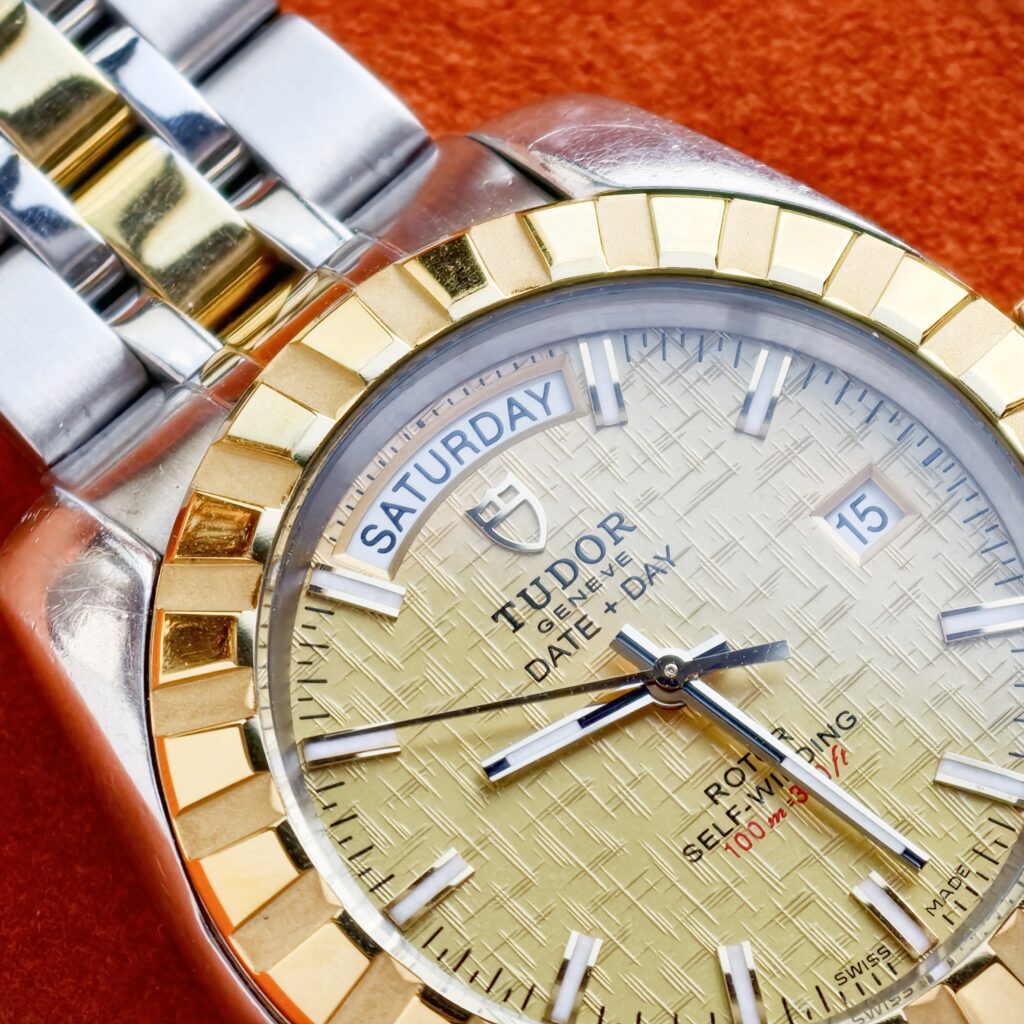
And then there is the text. “TUDOR GENEVE.” “DATE+DAY.” “ROTOR SELF-WINDING.” “100m=330ft” in that distinctive Tudor red. “SWISS MADE.” It is a crowded dial by modern standards, and yet it never feels busy. Every line earns its place.
The Case and Bezel: Substance Over Spectacle
At 41 millimeters, the 23013 occupies that sweet spot between vintage elegance and modern presence. It wears smaller than its dimensions suggest — the lug-to-lug is reasonable, the case profile is slim enough to slide under a cuff, and the overall proportion is, to my eye, near-perfect for a daily wearer.
The fluted bezel in 18k yellow gold is the watch’s most overtly decorative element, and it is also its most divisive. Some collectors find it too close to its Rolex cousin; I find it entirely its own. Tudor’s fluting is shallower, the facets broader, and the effect is less architectural and more ornamental — a gold ring that catches the light in a way that a smooth bezel never could. On the wrist, in motion, it throws off small flashes of warmth that make the steel case feel less utilitarian and more considered.
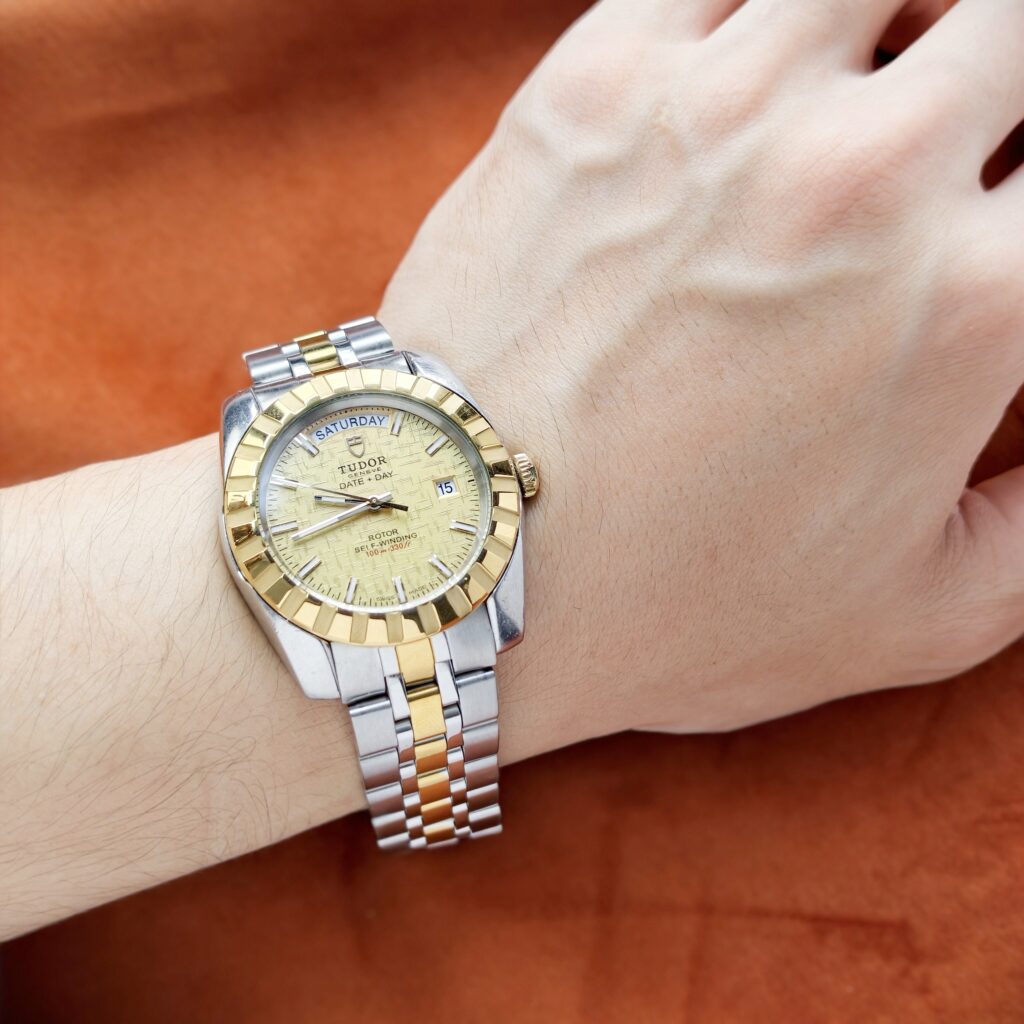
The screw-down crown, signed with the Tudor shield, is gold-capped and knurled for grip. It is a small detail, but a signed crown on a watch at this level was not always a given. The case shows honest wear in the photographs — light swirls on the steel, the kind of patina that comes from years of actual use rather than display-case storage. I would not have it any other way. A watch that has never been worn is a watch that has never been loved.
The Bracelet: A Two-Tone Jubilee Done Right
The bracelet is where many two-tone watches fall apart. Cheap gold plating, ill-fitting links, a clasp that feels like an afterthought — I have seen all of it. The 23013’s bracelet avoids every one of those pitfalls.
It is a five-link jubilee-style construction, alternating polished steel center links with gold-capped outer links, and the articulation is supple in the way that only a well-made bracelet can be. It conforms to the wrist rather than fighting it. The folding clasp bears the Tudor shield engraved into its brushed surface, and it closes with a satisfying click that tells you this is not a fashion accessory — it is a tool.
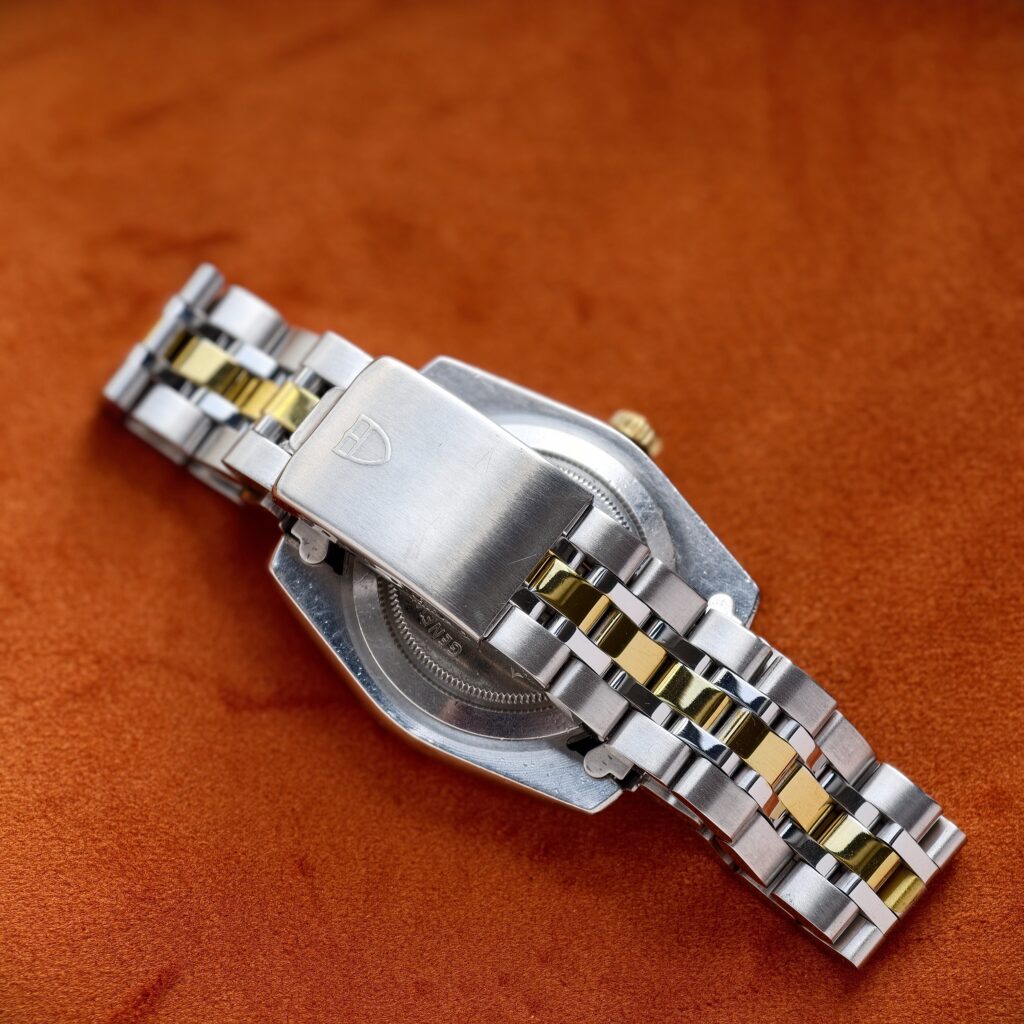
The gold on the bracelet is not plated. It is gold capped — a thicker layer of solid gold bonded to a steel core — which means it will wear for decades before showing through. This matters. A plated two-tone bracelet is a ticking clock; a gold-capped one is an heirloom.
The Movement: The Engine Nobody Talks About
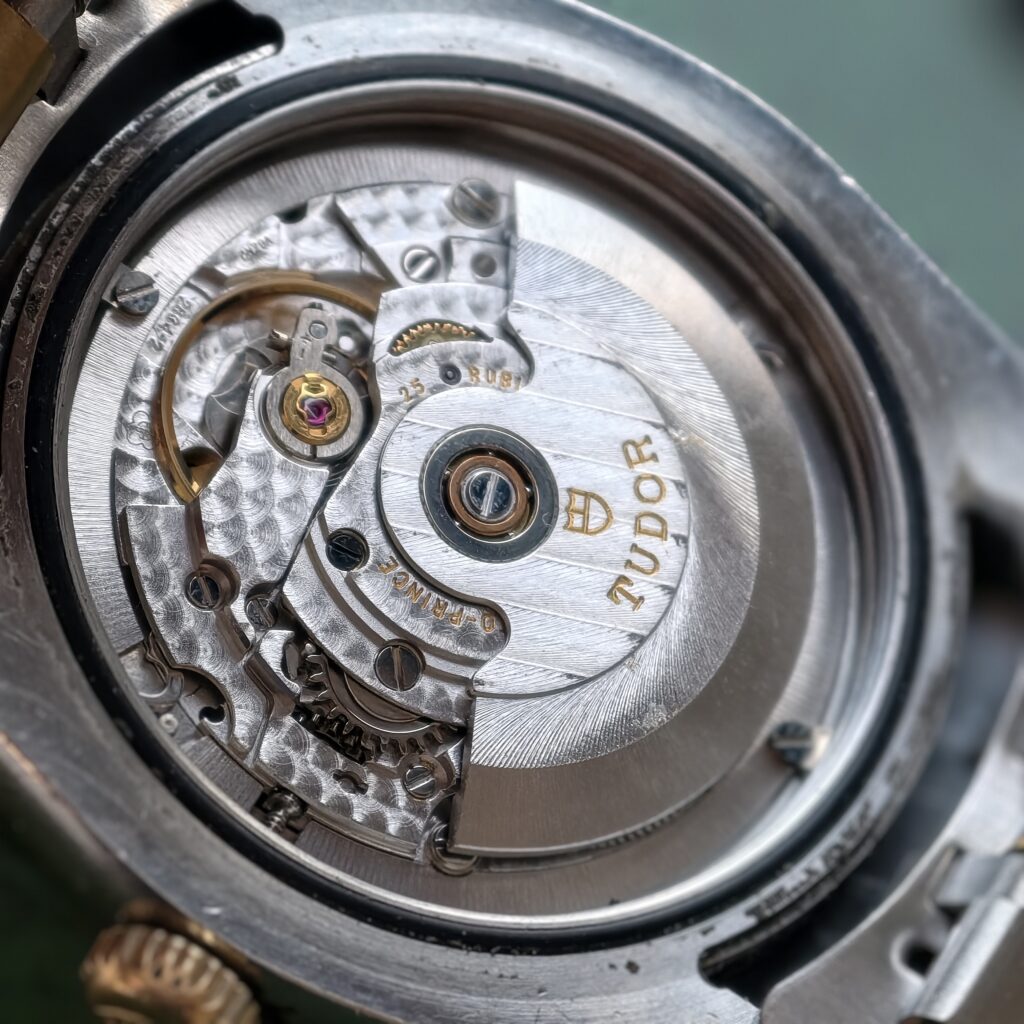
Inside beats an ETA-based automatic movement — for this reference, the caliber 2834-2, a workhorse that has powered literally millions of watches and will continue to do so for decades to come. It is not an in-house movement. It is not COSC-certified. It does not have a silicon hairspring or a 70-hour power reserve.
runfunc: 0; algolist: 0;
isCameraSense: false;
multi-frame: 1;
brp_mask:0;
brp_del_th:0.0000,0.0000;
brp_del_sen:0.0000,0.0000;
motionR: 0;
delta:1;
bokeh:1;
module: photo;hw-remosaic: false;touch: (-1.0, -1.0);sceneMode: 13107200;cct_value: 0;AI_Scene: (-1, -1);aec_lux: 221.0;aec_lux_index: 0;albedo: ;confidence: ;motionLevel: -1;weatherinfo: weather???, icon:1, weatherInfo:100;temperature: 40;zeissColor: nature;
What it has is serviceability. Any watchmaker in any city in the world can work on this movement. Parts are abundant. Costs are reasonable. It will run reliably for ten, fifteen, twenty years between services if treated with ordinary respect. In a collector’s market increasingly obsessed with proprietary movements and boutique engineering, the humble ETA 2834 is a reminder that a watch’s purpose is to tell time, and to keep telling time, and to be fixable when it stops.
The rotor is bi-directional, the winding is smooth, and the date changeover is crisp. What more do you actually need?
Why This Watch Matters
The Tudor 23013 Date+Day is not a watch you buy to impress people who know nothing about watches. It is a watch you buy to impress people who know everything about watches — because they will recognize what you have, and they will understand why you chose it.
It occupies a strange and wonderful space in the market. It is more interesting than a generic entry-level Swiss watch. It is less expensive than its Rolex equivalent. It has a complication (the day-date) that adds genuine utility. It has a dial texture that rewards close inspection. It has a two-tone construction that is, in 2026, undergoing something of a renaissance after years in the stylistic wilderness.
But more than any of that — it is a watch that feels lived-in. The photographs tell the story: the light scratches on the case, the gentle stretch of the bracelet, the way the gold has warmed with age rather than tarnished. This is a watch that has been on someone’s wrist through mornings and evenings, through ordinary days and memorable ones. It has accumulated history the only way a watch can — by being worn.
I collect watches for many reasons. I collect them for their mechanics, for their aesthetics, for their place in horological history. But I also collect them for the way they make me feel when I put them on in the morning. The Tudor 23013 makes me feel like I am wearing something substantial. Something that was built to last. Something that does not need to shout.
And in the end, is that not the highest compliment a watch can receive?
The Tudor Date+Day reference 23013 — stainless steel and 18k yellow gold, 41mm, automatic, 100m water resistance. A collector’s watch, through and through.
